Zerodha Review 2026: Charges, Offers, Promo Codes & Everything You Need to Know Before Opening an Account
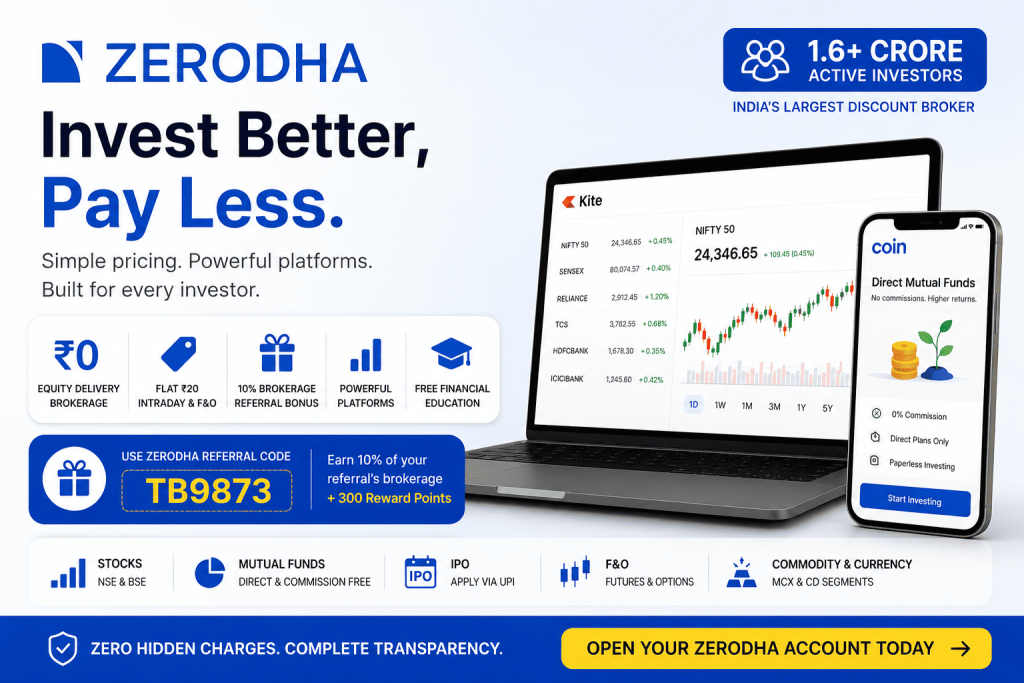
If you’ve been thinking about opening a demat account — or switching brokers — chances are Zerodha has come up more than once. And honestly, for good reason. With over 1.6 crore active investors, Zerodha isn’t just India’s largest discount broker; it’s the platform that quietly redefined how regular Indians think about investing.
But here’s the thing: the internet is full of surface-level comparisons. What you actually want to know before you sign up is straightforward — what will this cost me, what do I get, and are there any Zerodha promo codes or offers worth using?
This guide answers all of that. No fluff.
1. Latest Zerodha Offers & Promo Codes
Let’s get the good stuff out of the way first. Zerodha isn’t the kind of platform that runs flashy discount sales — they’ve always been priced at the lower end of the market by design. But there are genuine offers worth knowing about, especially if you’re opening an account this month.
| Category | Offer |
|---|---|
| Account Opening | ₹0 — Completely Free |
| New Account AMC | Free for Year 1 (accounts opened on/after June 1, 2026) |
| Referral Bonus | 10% of referred user’s brokerage + 300 Reward Points |
| Zerodha Referral Code | TB9873 |
| Equity Delivery Trades | ₹0 Brokerage — Always |
| Intraday & F&O | Flat ₹20 per executed order |
| Direct Mutual Funds | ₹0 Commission on Direct MFs (via Coin) |
| Minimum Balance | None — start with ₹1 |
A note on Zerodha coupon codes: Zerodha does not run coupon-code-based discounts in the traditional sense. Their pricing is already structured to be lean and transparent — the “offer” is essentially baked into the model. The referral programme, however, is genuine and one of the better ones in the space.
2. What is Zerodha? A Quick Overview
Founded in 2010 by Nithin Kamath and Nikhil Kamath, Zerodha was built on a simple, somewhat radical idea: stop charging investors a percentage of their trade value as brokerage. At the time, most full-service brokers were charging 0.5% or more per trade. Zerodha upended that with a flat fee.
It worked — spectacularly. Zerodha today is India’s largest stockbroker by active clients and net worth, a feat achieved without a single TV commercial or aggressive sales team. The growth has been almost entirely word-of-mouth.
The platform covers everything under one roof:
- Stocks — NSE & BSE listed equities, delivery and intraday
- Mutual Funds — Direct, commission-free MFs via Coin
- IPOs — Apply via UPI in under two minutes
- Futures & Options — Full F&O capability with margin support
- Currency & Commodity — MCX commodity trading and currency derivatives
- Fixed Income — Bonds, sovereign gold bonds, and G-secs
Beyond the trading terminal, what sets Zerodha apart is its ecosystem of companion tools — things like Varsity (free financial education), Console (back-office portal for P&L and tax reports), and the Kite Connect API for algo traders.
Who is Zerodha best for?
Honestly, it suits almost every type of investor: the beginner who wants to start a SIP without paying a commission, the active intraday trader who fires 20 orders a day and cares deeply about per-order cost, and the intermediate investor who wants clean charting tools and reliable execution. The one group it may not suit as well is someone who needs hand-holding — Zerodha is a self-serve platform and its support is entirely ticket-based.
3. How to Open a Zerodha Account?
This part is genuinely simple. The entire process is paperless and typically takes under 15 minutes of active effort — after that, you wait.
Step-by-Step Process
- Go to zerodha.com/open-account and enter your mobile number
- Verify with the OTP sent to your registered mobile
- Fill in your basic details — name and email
- Verify your email with a second OTP
- Enter your PAN number and Aadhaar details
- Complete e-sign via Aadhaar-based OTP and link your bank account
- Your account is activated within 24–72 working hours
That’s it. No branch visit, no physical paperwork (for resident individuals).
Documents You’ll Need
- PAN Card (mandatory)
- Aadhaar Card (must be linked to your mobile number for OTP)
- Cancelled cheque or bank statement
- Income proof (only required if you plan to trade in F&O)
Zerodha Account Types
Not everyone investing is the same. Zerodha offers several account configurations:
| Account Type | Best Suited For |
|---|---|
| Individual Account | Most investors — equity, MFs, F&O |
| Minor Account | Investing on behalf of children, managed by a guardian |
| HUF Account | Hindu Undivided Families — tax-efficient family investing |
| NRI Account | Non-Resident Indians (requires offline documentation) |
| Corporate / LLP | Business surplus management and investing |
One thing worth knowing: SEBI regulations allow only one demat account per PAN with any single broker. So if you already have an account at Groww or Angel One, you can open a Zerodha account alongside — but not a second one at Zerodha.
4. Zerodha Charges — Complete Breakdown
This is where most guides either oversimplify or bury you in asterisks. Here’s the full picture, presented clearly.
Zerodha’s pricing philosophy is simple: ₹0 on equity delivery, flat ₹20 on everything else, and complete transparency on statutory charges.
4.1 Account Opening & AMC Charges
| Charge | Amount |
|---|---|
| Trading Account Opening Fee | ₹0 |
| Demat Account Opening Fee | ₹0 |
| Trading Account AMC | ₹0 |
| Demat Account AMC (Year 1) | ₹0 (for accounts opened on/after June 1, 2026) |
| Demat Account AMC (Year 2 onwards) | ₹300 + 18% GST = ₹354/year (charged quarterly at ₹75/quarter) |
| NRI Account Opening | ₹500 (one-time) |
| Corporate Demat AMC | ₹1,000 + GST/year |
| Commodity Account AMC | ₹100 + GST/year |
The AMC of ₹354/year from the second year onwards is Zerodha’s one real cost disadvantage compared to platforms like Groww and Dhan, which charge zero lifetime AMC. Whether that ₹354 matters to you depends entirely on how much you’re investing — for anyone trading or holding regularly, it’s negligible.
4.2 Brokerage Charges — Segment-Wise
| Segment | Brokerage |
|---|---|
| Equity Delivery (CNC) | ₹0 |
| Equity Intraday (MIS) | ₹20 or 0.03% — whichever is lower |
| Equity Futures | ₹20 or 0.03% — whichever is lower |
| Equity Options | Flat ₹20 per executed order |
| Currency Futures | ₹20 or 0.03% — whichever is lower |
| Currency Options | Flat ₹20 per executed order |
| Commodity Futures (MCX) | ₹20 or 0.03% — whichever is lower |
| Commodity Options (MCX) | Flat ₹20 per executed order |
| Margin Trading Facility (MTF) | ₹20 or 0.3% — whichever is lower |
| Direct Mutual Funds (Coin) | ₹0 |
| Call & Trade (dealer-assisted) | ₹50 + 18% GST (over and above standard brokerage) |
Important clarification: Zerodha charges per executed order, not per trade. If your single order is filled in 5 different market trades, you’re still paying ₹20 total — not ₹100. Cancelled or rejected orders attract zero brokerage.
4.3 Statutory & Government Charges
These aren’t Zerodha’s charges — they apply at every broker in India, set by SEBI and the government. They appear on your contract note and are worth understanding.
| Tax / Charge | Equity Delivery | Equity Intraday | Equity Futures | Equity Options |
|---|---|---|---|---|
| STT | 0.1% both sides | 0.025% sell only | 0.05% on sell | 0.15% on sell premium |
| Exchange Transaction Charge (NSE) | 0.00325% | 0.00325% | As applicable | As applicable |
| Exchange Transaction Charge (BSE) | 0.003% | 0.003% | As applicable | As applicable |
| SEBI Turnover Fee | ₹10 per crore | ₹10 per crore | ₹10 per crore | ₹10 per crore |
| GST | 18% on brokerage + txn charges | 18% | 18% | 18% |
| Stamp Duty (buy side only) | 0.015% | 0.003% | 0.002% | 0.003% |
Budget 2026 update: From April 1, 2026, STT on futures increased to 0.05% on sell and options STT increased to 0.15% on sell premium. This applies uniformly across all brokers — Zerodha has no control over it.
4.4 Demat Account Transaction Charges
| Charge | Details |
|---|---|
| DP Charge (on selling delivery shares) | ₹13.5 + GST per scrip per day |
| Off-Market Transfer | 0.03% of value or ₹25, whichever is higher + GST |
| Dematerialisation (physical to demat) | ₹150 per certificate + ₹100 courier |
| Pledge Creation | ₹30 per request + GST |
| Pledge Invocation | ₹20 per request |
| Cheque Bounce | ₹350 per instance |
| Physical Contract Notes | ₹20 per note |
| Trade SMS Alerts | ₹1 per SMS |
| KRA Upload/Download | ₹50 per request |
What’s a DP charge? This one surprises many new investors. Even though equity delivery brokerage is ₹0, every time you sell delivery shares, Zerodha’s depository partner (CDSL) charges ₹13.5 + GST per ISIN per day. This is a depository fee, not a Zerodha fee — and it applies at every broker.
4.5 BSDA — Reduced AMC for Smaller Portfolios
If your total demat holdings are below ₹10 lakh, you may qualify for a Basic Services Demat Account (BSDA), which significantly reduces your AMC:
| Holding Value | Annual AMC |
|---|---|
| Up to ₹4 lakh | ₹0 |
| ₹4 lakh to ₹10 lakh | ₹100/year |
| Above ₹10 lakh | Standard ₹300 + GST |
This is a SEBI-mandated provision and is available automatically based on your portfolio value.
4.6 NRI Account Charges
NRI accounts are slightly different in cost structure due to regulatory requirements:
| Charge | Details |
|---|---|
| Account Opening | ₹500 (one-time) |
| Equity Brokerage | 0.1% or ₹200 per executed order — whichever is lower |
| F&O Brokerage | ₹100 per executed order |
NRI accounts also require offline documentation — passport copy, overseas address proof, and a PIS or non-PIS letter from your Indian bank. The online-only process does not apply here.
5. Zerodha vs Groww vs Angel One vs Dhan
Here’s an honest side-by-side — because the “which broker” question doesn’t have a universal answer.
| Feature | Zerodha | Groww | Angel One | Dhan |
|---|---|---|---|---|
| Equity Delivery Brokerage | ₹0 | ₹20 or 0.1% | ₹0 | ₹0 |
| Intraday / F&O Brokerage | Flat ₹20 | Flat ₹20 | Flat ₹20 | Flat ₹20 |
| Demat AMC | ₹300/year (Year 2+) | ₹0 | ₹0 (Year 1) | ₹0 lifetime |
| DP Charge (on delivery sell) | ₹13.5 + GST | ₹20 + GST | ₹20 + GST | ₹12.5 + GST |
| Direct Mutual Funds | ₹0 | ₹0 | ₹0 | ₹0 |
| Platform Quality | ★★★★★ | ★★★★☆ | ★★★★☆ | ★★★★☆ |
The honest take:
- Zerodha’s disadvantage is the ₹354/year AMC from Year 2. For pure-cost minimisers with small portfolios, Groww or Dhan edges ahead.
- Zerodha’s advantage is platform depth. Kite’s charting, GTT orders, basket order capability, and the broader ecosystem (Coin, Console, Varsity) remain the benchmark that others are still catching up to.
- Groww wins for simplicity and zero lifetime AMC — a solid pick for first-time investors who just want to start a SIP.
- Dhan is strong on UI and zero AMC, with a growing options trading community.
- Angel One has a decent research suite but trails Zerodha in platform reliability.
For anyone trading actively or holding a portfolio above ₹5 lakh, Zerodha’s platform quality more than justifies the AMC. For a genuine beginner just starting a ₹500/month SIP? Groww or Zerodha are equally fine.
6. Zerodha’s Platforms & Tools
Kite — The Trading Terminal
Kite is Zerodha’s flagship trading platform, available as a web app and on Android & iOS. It supports:
- Real-time charts with 100+ indicators
- GTT (Good Till Triggered) orders — set price alerts that auto-place orders
- Basket orders — execute multiple buy/sell orders simultaneously
- Advanced F&O analytics and option chain views
- Instant fund transfers via UPI
No standalone desktop installer exists — but Kite Web works seamlessly in Chrome or Firefox on any desktop or laptop.
Coin — Direct Mutual Funds
Coin is Zerodha’s mutual fund investing platform. It gives you access to commission-free direct mutual funds — the same ones that regular (regular plan) MFs invest in, but without the 0.5–1% distributor commission that quietly erodes your returns over the years. If you’re investing in MFs long-term, direct plans via Coin can make a meaningful difference over a decade.
Console — Your Back-Office
Console is where the serious record-keeping happens: P&L reports segment-wise, capital gains statements for filing ITR, tradebook downloads, fund statements, and portfolio snapshots. It also auto-generates tax P&L reports that most CAs accept directly.
Varsity — Free Financial Education
Varsity is arguably one of the most underrated things Zerodha offers. It’s a completely free, multi-module financial education platform covering everything from What is the Stock Market? to deep dives on options pricing theory and risk management. Available on web and as a mobile app, it’s genuinely good — not just marketing.
Kite Connect API
For those who want to build their own trading systems, Kite Connect provides REST APIs with WebSocket streaming. There’s a nominal monthly fee, but the documentation is thorough, and the community around it is active.
7. Frequently Asked Questions
Account Opening
Yes. No account opening fee, no trading account AMC, and no demat AMC for the first year on new resident individual accounts opened from June 1, 2026, onwards.
If you complete the process in one sitting with your Aadhaar OTP ready, activation typically happens within 24–72 working hours. Weekend submissions may take slightly longer.
Yes — through a parent or guardian, who manages the account until the minor turns 18. Equity delivery and mutual fund investments are allowed; F&O and intraday trading are not permitted in minor accounts.
Yes, but NRI accounts require offline documentation (passport, overseas address proof, PIS/non-PIS letter) and carry a one-time ₹500 opening charge. The fully online process applies only to resident Indians.
No — SEBI permits only one demat account per PAN with any single broker. You can, however, hold accounts at multiple brokers simultaneously.
Brokerage & Charges
No. Brokerage is charged only on executed orders. Cancelled or rejected orders cost you nothing.
Yes, always — this has been Zerodha’s policy since 2010. The DP charge (₹13.5 + GST per ISIN when you sell) is separate and charged by CDSL, not Zerodha itself.
Yes. The flat ₹20 fee applies per executed order regardless of profit or loss. It’s a flat fee — not a performance cut.
No. Zerodha does not charge for withdrawals. Standard bank-side NEFT/IMPS charges may apply depending on your bank, but Zerodha’s end is free.
If you call Zerodha’s dealer desk to place an order, an additional ₹50 + 18% GST is charged per executed order on top of regular brokerage. Use the app — it’s free.
Trading & Investing
Equities (delivery & intraday), F&O, currency derivatives, commodity trading (MCX), direct mutual funds, IPOs via UPI, sovereign gold bonds, and government securities — all from one account.
None. You can start a mutual fund SIP with ₹100 or buy shares of any stock at current market price.
Not directly. You can invest in US-focused ETFs or mutual funds listed on Indian exchanges through the platform, but there’s no direct international stock trading.
Yes, via the Kite Connect API. It’s a developer-grade REST + WebSocket API with a nominal monthly access fee.
Account Management
Via UPI, net banking, or NEFT/RTGS through the Kite app or web. UPI and net banking transfers reflect immediately.
Go to Funds in Kite, raise a withdrawal request. Money reaches your registered bank account by the next working day (T+1 settlement).
Through the ticketing system at support.zerodha.com. Zerodha does not offer real-time phone support for general queries — all support is ticket-based. For trading issues, there is a dedicated dealer desk.
No — account closure requires a signed physical form sent by courier to Zerodha’s registered office. Ensure all holdings are sold, and your account balance is zero before submitting.
Final Word
Zerodha isn’t perfect — the AMC from Year 2, the ticket-based support, and the absence of a desktop app are real drawbacks some users feel. But on the things that matter most to most investors — pricing transparency, platform reliability, charting quality, and the breadth of what you can invest in — it’s hard to argue with 1.6 crore active users.
If you’re opening an account this month, the free AMC for Year 1 makes it an even easier entry. After that, whether ₹354/year is worth it for the platform you get is a call only you can make — but for most people who trade or invest with any regularity, it is.